The Adventure
I recently moved across the ocean to start a new chapter of my life as an English teacher in South Korea. I was placed in Busan, but when the time came for me to fly over, I decided to give myself an extra day to explore the nation’s massive capital city first.
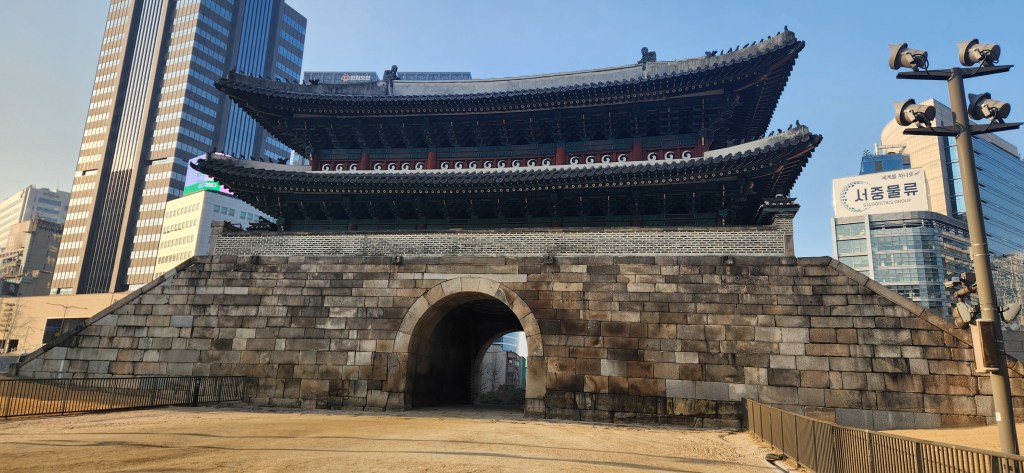
I arrived at Incheon International Airport on February 17th, 2026, and already had an Airbnb booked near the airport for convenience. I was quite tired after a 15-hour flight, but still managed to wake up early the next day for a train ride to Seoul. Very conveniently, most of the attractions that I wished to see were very near the main Seoul Station. The first of these was Sungnyemun Gate (숭례문), very close to the station and my first exposure to the architectural style which drew me to Asia and Korea. I was thrilled when I first came across it, unable to hold in my smile at seeing something like it in person for the first time. I spent a good deal of time going around it and reading the information plaque, unaware that that was just the beginning.
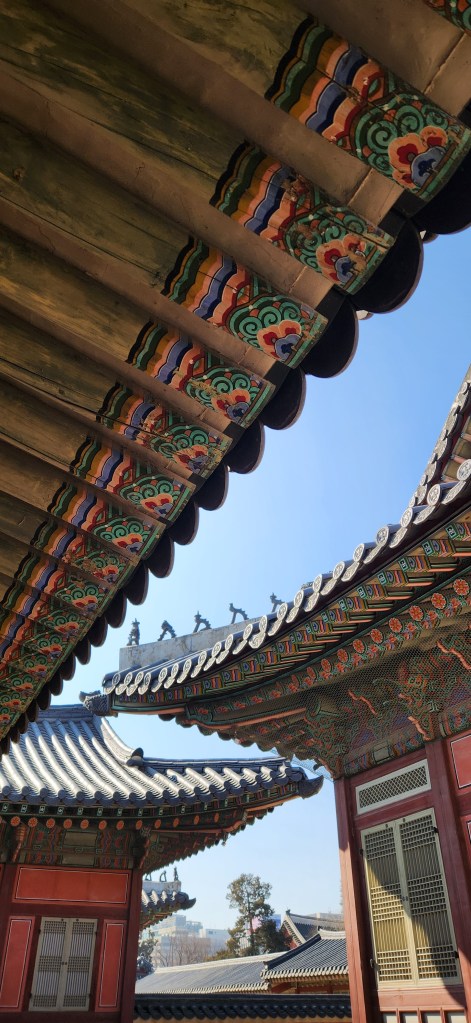
I continued north from there, making my next stop Deoksugung Palace (덕수궁). It was the day after Seollal (Korean Lunar New Year), so entrance was free, though I was glad to notice that it wouldn’t put you out very much at all if you did have to pay. I spent quite a while here as well, as there were so many buildings scattered across the property. Most were brightly coloured in reds and greens, while others had a more natural wood look. All of them had the iconic roof shape with the upturned corners, and detailed beams supporting it from underneath. There were also a couple of western-style buildings at the back of the property, which I believe had been commissioned by an important Korean figure, but which were now turned into museums. With much still to see, however, I turned my path to the next palace.
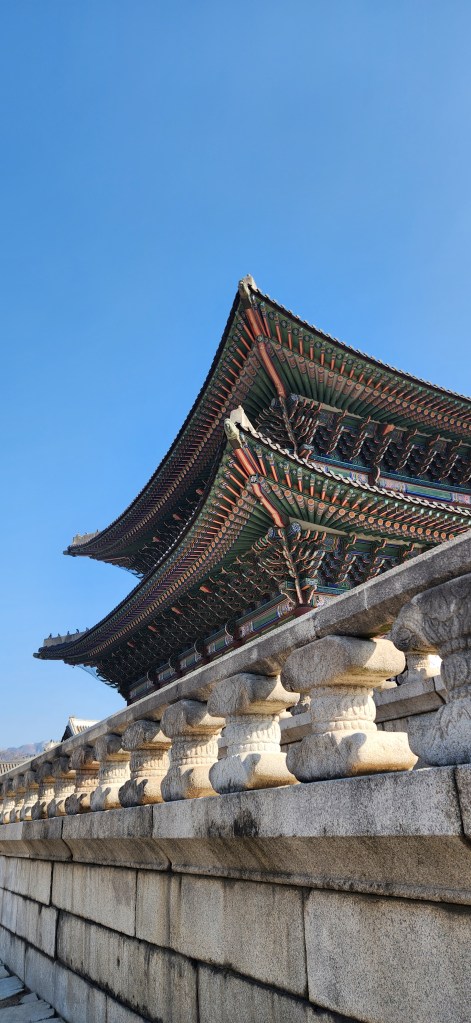
There are many palaces in Seoul, but the biggest and most popular is definitely Gyeongbokgung Palace (경복궁). I made my way down the road through Gwanghwamun Square (광화문광장) until I eventually came to the palace gates. It was called Gwanghwamun Gate (경복궁 광화문), and entrance through it was again free. From that point on, for quite a while, I explored every possible alley within the walls surrounding the palace. There was much to be seen right from the start. Arriving in a large, open square, I was surrounded by beautiful architecture, from covered walkways along the walls to detailed gates leading in any direction I could have wished to go, to the promise of even more to see within just a short walk. The gate on the far end of the square took me into a similar open space, but with a stream running through the middle. Many people were visiting the palace grounds, and many were dressed in hanbok, a beautiful and traditional Korean style of clothing. In these open spaces, you could see them everywhere, taking photos by the gates or in the walkways. The crowds were also dense near the larger buildings, like the main palace building. However, as I got deeper into the palace grounds, the crowds thinned, and I was able to have a more serene adventure.
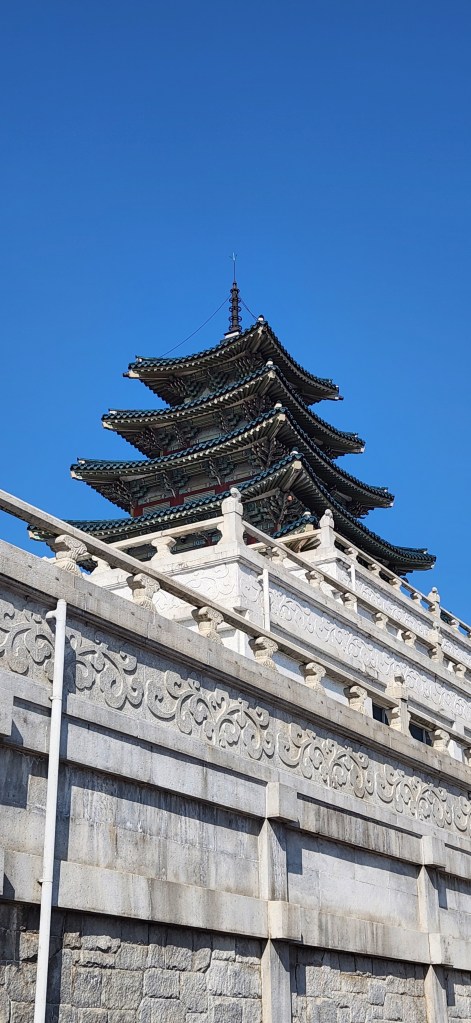
With limited time in my day, and having already spent more time than planned in Gyeongbokgung, I made my way back through the palace grounds and departed, heading towards my next destinations. I headed east from there, towards a group of three landmarks all close together. These were the remaining two palaces, Changgyeonggung (창경궁) and Changdeokgung (창덕궁), as well as Jongmyo Shrine (종묘). These three were similar in architectural style to Gyeongbokgung, but smaller in scale. Because the three were all close together, however, and all connected by paths, it made for a decent-sized area and a decent length of walk. From a hill just north of the palaces, I was able to get a good view of the mountain Namsan (남산) and the famous N Seoul Tower (N서울타워) at its peak. I made that my next destination, heading back through the palace grounds on my way out.
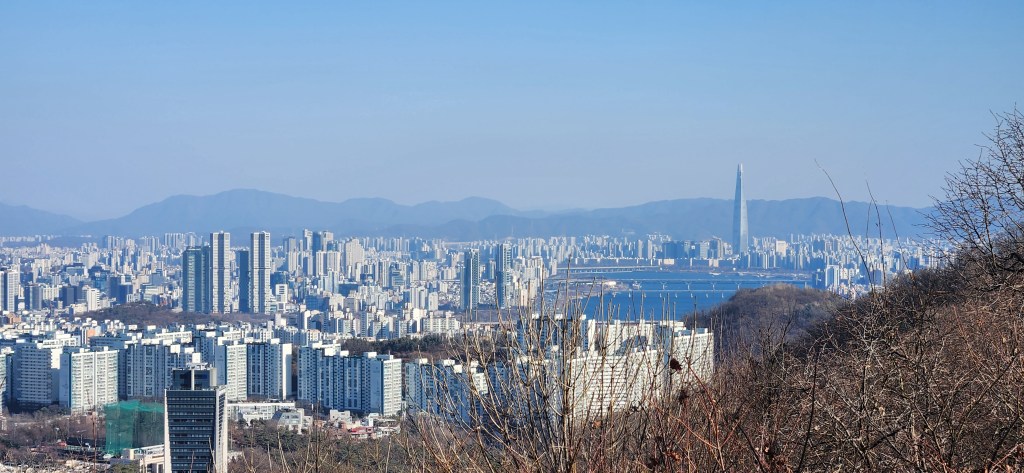
It was a bit of a walk up to Namsan, but the city was alive, especially in some of the communities around the mountain, with Seollal festivities. Everyone was out celebrating, there was food everywhere, and even an impressive martial arts performance, which I stopped to watch for a moment. Once I was in the mountains, however, the business of Seoul largely disappeared. There were many people on the trails, but Namsan is large enough and tall enough that when hiking up it, you almost forget that you are in the middle of a city of 10 million people. My hike took me around much of the mountain before I arrived at the top, so I was able to get a 360-degree view of the whole city as I walked. Seoul really is a massive city, unlike anything I have seen before. From each point I stopped, I could see mountains rolling off into the distance, the metropolis snaking around them and filling every empty spot between myself and the horizon. And the buildings that disappeared into the horizon were not just homes, but massive apartment buildings, housing hundreds or thousands of people each.
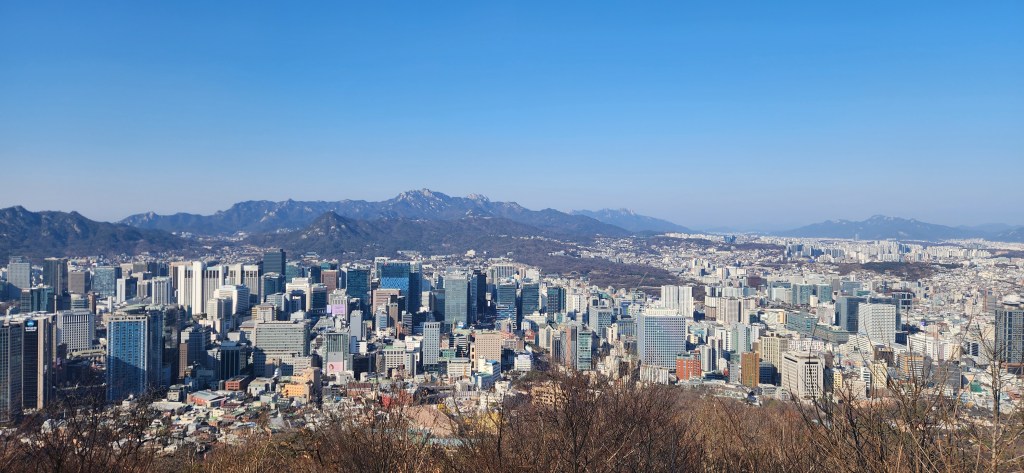
At the top of Namsan, there were more festivities taking place. People dressed in traditional clothing were showing off traditional Korean weaponry, which was quite cool to see. Of course, the view from the very top is also much better and much wider than it is on the hike up. N Seoul Tower also stands on the mountain’s peak, but I didn’t go in. It did make for some nice pictures, though.
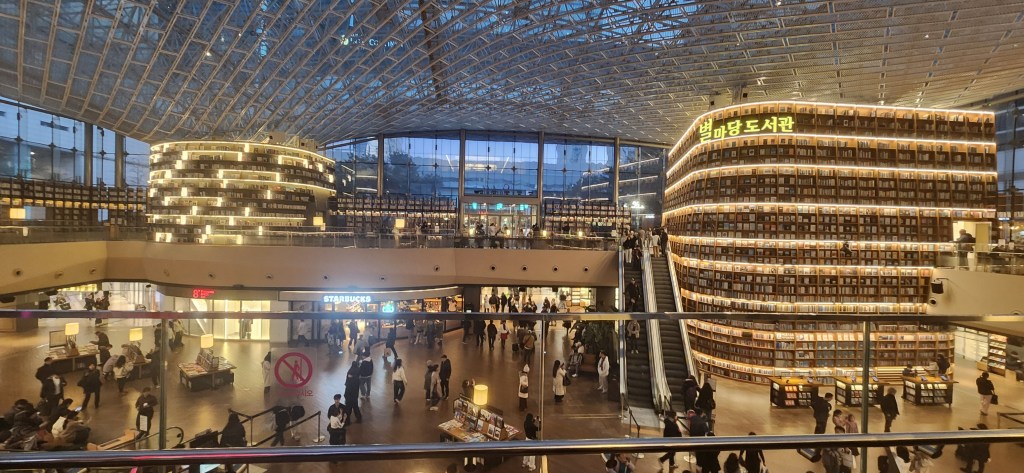
From the top of Namsan, I made the quite crazy decision to head to Starfield Library (별마당 도서관) next… by foot. For those of you not familiar, the famous library is quite a distance from Namsan, and I would say the walk took me somewhere between three and three-and-a-half hours. The walk took me across the Han River, which I was excited to see, and through the district of Gangnam, which you may be familiar with if you listened to popular music almost 15 years ago. It was not the most scenic of routes, but I was glad to walk for a while. After walking for much of the day, however, I was rather spent by the time I arrived at the library. It was indeed a beautiful library, which is hard to describe but certainly unlike any library I had seen before. I took it in, but then I did need to sit down to rest, and also decide my next move.
It was getting late, and I decided there wasn’t much left I could do that day. I had been hoping to see the tall Lotte World Tower, but unfortunately, it was still a bit of a way away, and I decided to save it for another time. Fortunately, I had seen it in the distance from the top of Namsan, and wasn’t altogether disappointed to be leaving when I did. From Starfield Library, I took the train back to my Airbnb in Incheon, with just one transfer at Gimpo Airport. I had seen so much, and I knew there was still so much else to see. I had lots to do in the coming weeks, getting ready for work and settling into my new place, but living in Korea has given me a great position to revisit Seoul someday and see what else it has to offer.
Highlight
I think the highlight for me was definitely Gyeongbokgung. My main interest in coming overseas to this part of the world was to explore its history, and Gyeongbokgung is one of the best places to experience that in Korea. I made many of Seoul’s historic landmarks my first stops, but at Gyeongbokgung in particular, I spent more time in it than I had anticipated and had to rush out eventually to see as much of the city as I could in what little time I had. I explored every corner of Gyeongbokgung and was thrilled to discover, as I kept walking, that the palace property was quite extensive. The large and small buildings were all so beautiful, and even the walls lining the courtyard were wonderfully decorated. The nature surrounding and incorporated into the palace was also beautiful, even in the winter.
Cost
Since entrance to the palaces was free, my only costs for this trip were food (which I ate very little of) and the transportation to and from Seoul. Crunching the numbers in hindsight is a bit hard, but I believe I paid about $12.79 CAD for transportation, which includes trips from the airport to my Airbnb, then to Seoul, then all the way back to the airport (via my Airbnb) for pickup. Between these charges, I spent $9.18 CAD, all at convenience stores, for food. I’ll account for the Airbnb as well, which cost me only $75.35 CAD for two nights.
Concluding Thoughts
Seoul is almost certainly a city I will revisit. It’s so large that it’s impossible to be bored or have nothing to do. From its history to its modern districts, showing the rapid development of South Korea, the city has many different types of beauty to admire. From the big city to the mountaintops, the city appeases city people and nature-lovers equally. I would definitely recommend a visit to Seoul and look forward to my own return someday.
 Matthew C. Schmidt
Leave a comment